Metal roof or shingles for a Hill Country house?
Honest comparison on cost, life, hail, heat, noise and resale — with the cases where each one is the right answer.
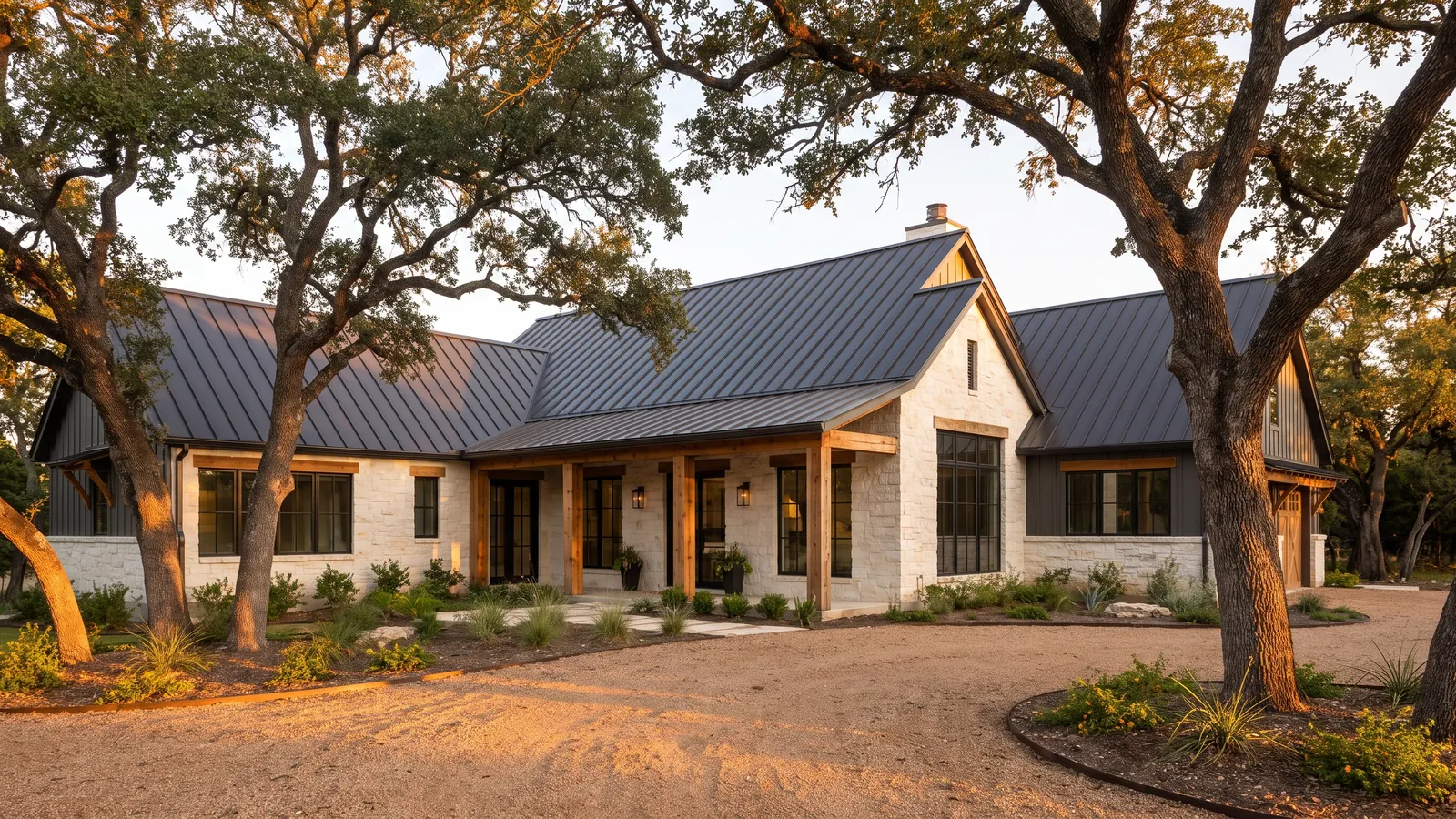
We install both, so we don't have a side. What we have is a pattern: in New Braunfels proper, on subdivision houses people plan to sell in ten years, Class 4 shingles are usually the right call. Out toward Canyon Lake, Spring Branch and Vintage Oaks, on a stone-and-cedar house someone plans to keep, standing-seam metal usually is. Here's the comparison behind that.
Cost
Architectural shingles: $4.50–$7.50 per square foot installed; Class 4 $5.50–$8.50. Standing-seam steel: $10–$16 per square foot. On a 2,500-square-foot roof that's roughly $14,000 for Class 4 shingles versus $32,000 for standing seam. Screw-down R-panel metal splits the difference at $6–$9 but has exposed fasteners that need attention every 10–15 years.
Lifespan
A well-installed, ventilated architectural shingle roof in Central Texas lasts 18–25 years; the sun and the hail decide which. Standing-seam steel with a Kynar (PVDF) finish lasts 40–60 years, and the panels typically outlast the finish warranty. Over a 50-year horizon you buy one metal roof or two to three shingle roofs, which is where the cost gap closes.
Hail
Metal wins clearly. Steel panels dent in big hail but don't leak; a Class 4 shingle survives most Comal County hail but can be totaled by the rare softball storm. Both earn insurance discounts; some carriers exclude cosmetic dent damage on metal, which is worth reading in your policy.
Heat
Metal wins again. A light-colored or cool-pigment Kynar metal roof reflects most solar radiation and cools quickly after sunset; attics under metal run 20–30 degrees cooler than under dark shingles. That shows up as a smaller AC bill and a longer-lived attic.
Noise
Mostly a myth on a house. Over solid decking and underlayment with an insulated attic, rain on standing seam is no louder than on shingles. On a barn or porch with open framing, yes, it's loud.
Looks and HOAs
Standing seam suits limestone, cedar and modern farmhouse styles and is allowed by nearly every HOA in Comal County with a color submittal. On a brick 1990s two-story in a shingle neighborhood it can look out of place; that's a taste call.
Resale
Metal adds to the value of a Hill Country home and is a selling point in Vintage Oaks or Mystic Shores. In a subdivision it mostly signals 'the roof is done' — worth something, but not the full cost. Class 4 shingles with a transferable warranty carry the same message for a third of the price.
The decision
- Shingles (Class 4) if you'll sell within ten years, the house is in a shingle neighborhood, or the budget is the budget.
- Standing-seam metal if you'll keep the house, it's a Hill Country or acreage home, it's under big trees, or it has a barn and shop you want to match.
- R-panel metal on outbuildings and porches, and on a house only where cost rules and someone will maintain the fasteners.
Common questions
Is a metal roof worth it in Texas?
If you're keeping the house more than ten years, usually yes: it's the last roof you'll buy, it handles hail and heat better, and it earns the insurance discount. If you're selling soon, a Class 4 shingle roof gives the buyer the same reassurance for far less.
Does a metal roof make the house hotter?
The opposite. A reflective Kynar-finished metal roof lowers attic temperatures compared with dark shingles, especially in light colors.
Can I put metal over my existing shingles?
It's done, but we don't recommend it: you can't inspect or repair the decking, the old shingles hold heat, and it adds weight. Tear-off costs about $1 a square foot and is worth it.
What's the best color for a metal roof in the Hill Country?
Charcoal, dark bronze and galvalume (bare) are the most common on stone houses; lighter colors run cooler. Most HOAs accept any of the standard Kynar palette.
Do metal roofs attract lightning?
No. Lightning strikes the tallest object regardless of material, and a metal roof is actually safer in a strike because it conducts to ground and doesn't burn.
Related: Metal roofing · Shingle roofing · Roof replacement cost · Class 4 shingles